RAID LEVEL 6: Independent Data Disks with Two Independent Parity Schemes

Two independent parity computations must be used in order to provide protection against double disk failure. Two different algorithms are employed to achieve this purpose.
RAID Level 6 requires a minimum of 4 drives to implement
Recommended Products
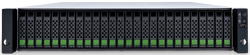
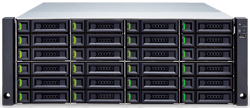
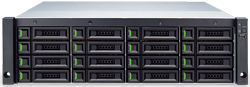
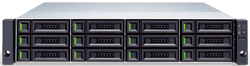
Featured Product
Characteristics & Advantages
- RAID 6 is essentially an extension of RAID level 5 which allows for additional fault tolerance by using a second independent distributed parity scheme (dual parity)
- Data is striped on a block level across a set of drives, just like in RAID 5, and a second set of parity is calculated and written across all the drives; RAID 6 provides for an extremely high data fault tolerance and can sustain multiple simultaneous drive failures
- RAID 6 protects against multiple bad block failures while non-degraded
- RAID 6 protects against a single bad block failure while operating in a degraded mode
- Perfect solution for mission critical applications
Disadvantages
- More complex controller design
- Controller overhead to compute parity addresses is extremely high
- Write performance can be brought on par with RAID Level 5 by using a custom ASIC for computing Reed-Solomon parity
- Requires N+2 drives to implement because of dual parity scheme
Recommended Applications
- File and Application servers
- Database servers
- Web and E-mail servers
- Intranet servers
- Excellent fault-tolerance with the lowest overhead


Comments
Post a Comment